


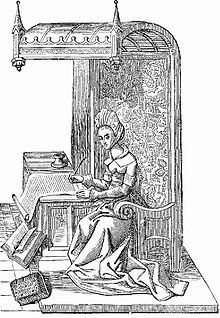
Esta poeta de nacionalidad francesa fue una de las voces que escribió contra el silencio en un momento en que Europa estaba sumida en guerras, dogmas y muy concretamente plumas masculinas que eran las que dictaban al mundo.
Transcurría el siglo XV y ella decidió no quedarse callada y con su pluma y su tinta utilizada como escudo hablo aunque el eco de su voz fue amortiguado durante muchos siglos por los llamados «grandes hombres de letras».
Una mujer que fue madre de tres hijos. y se quedo viuda con tan solo 25 años quedando también huérfana de padre. , una libre pensadora pero sobre todo una mujer muy valiente que nació en el año 1364 en Venecia y se crio en Francia bajo el reinado de Carlos V.
Era su padre astrólogo y médico del rey con lo cual pudo acceder a cierta educación que a otras niñas no se les concedía, además de bordar en el silencio o como yo lo llamaría mejor «bordar el silencio» tomo lecciones de latín, historia, filosofía y ciencias.
Tuvo que tomar una difícil y necesaria decisión, vivir de su escritura escribiendo poemas y tratados políticos, manuales de ética e incluso reflexiones filosóficas. De manera firme y directa escribía pero no conseguía ser reconocida en ese mundo en el que vivía.
Realizó una proeza escribió «El Roman de la Rose» un texto que fue leído y respetado por los más cultos del momento. En él una mujer era reducida a objeto de deseo y despojada de la razón rebajándola por su inferior naturaleza. Denunció la «misognia» disfrazada de poesía.
Era un texto en el que con sabiduría disfrazó el odio. Denunció, desafió esa tradición intelectual que se basaba únicamente en oprimir a las mujeres.
Posteriormente escribió «La Ciudad de las Damas» en la que describía un hogar donde eran honradas todas esas mujeres sabias y justas. Mujeres como Juana de Arco, Hipatia, Semíramis entre otras…
Fue el primer discurso literario en el que el protagonismo recaía sobre la dignidad femenina sin pedir permiso ni implorar justicia.
Durante su vida fue leía pero tras su muerte fue desapareciendo de la historia gracias como era habitual a que las crónicas estaban en manos de plumas masculinas hasta ser ignorada.
Por suerte para nosotros su legado permanece vivo, quedó en las bibliotecas de monjas y copistas, en esos «márgenes» donde una voz escrita no callaba lo que no podía pronunciar en voz alta.
Se cree fue la primera mujer que vivió de la escritura profesional en Europa y en preguntarse sin duda «¿Por qué los hombres temen tanto a las mujeres sabias? ¿Y si la inteligencia no tenía genero?
Y hoy vuelven a leerse sus palabras, por qué es una acto de justicia.
Cité des Dames (La Ciudad de las Damas), escrita en 1405, un fragmento traducido al español:
«En la ciudad que quiero fundar,
no habrá engaño ni falsedad,
ni hombres crueles que difamen
a las mujeres con tal afán.
Allí reinará la Razón,
Justicia, Rectitud y Compasión.
Las damas serán las defensoras
del alma, del arte y de la razón.»
@ María José Luque Fernández.
@Imagen Pinterest
<<<<>>>>
TRADUCCIÓN AL INGLÉS
This French poet was one of the voices who wrote against silence at a time when Europe was immersed in wars, dogmas, and, very specifically, male pens that dictated to the world.
It was the 15th century, and she decided not to remain silent. With her pen and her ink used as a shield, she spoke, even though the echo of her voice was muffled for many centuries by the so-called ‘great men of letters.’
A woman who was the mother of three children and widowed at only 25, also left fatherless. A free thinker, but above all, a very brave woman who was born in 1364 in Venice and raised in France under the reign of Charles V.
Her father was an astrologer and physician to the king, which allowed her access to a kind of education other girls were not granted. In addition to embroidery in silence—or, as I would call it better, ‘embroidering silence’—she took lessons in Latin, history, philosophy, and science.
She had to make a difficult yet necessary decision: to live by her writing. She wrote poems and political treatises, manuals of ethics, and even philosophical reflections. She wrote firmly and directly, but still failed to be recognized in the world in which she lived.
She accomplished a remarkable feat: she wrote Le Roman de la Rose, a text read and respected by the most cultured of the time. In it, a woman was reduced to an object of desire and stripped of reason, diminished because of her ‘inferior’ nature. She denounced misogyny disguised as poetry.
It was a text that, with cunning, masked hatred. She denounced and defied that intellectual tradition based solely on oppressing women.
Later, she wrote The Book of the City of Ladies, where she described a place that honored all wise and just women—women such as Joan of Arc, Hypatia, Semiramis, among others…
It was the first literary discourse in which the spotlight fell upon female dignity, without asking permission or begging for justice.
During her lifetime she was read, but after her death she disappeared from history—as was common—since chronicles were in the hands of male pens, until she was ignored altogether.
Fortunately for us, her legacy remains alive. It survived in the libraries of nuns and scribes, in those ‘margins’ where a written voice could say what could not be spoken aloud.
She is believed to have been the first woman in Europe to live from professional writing, and to ask herself, without doubt: ‘Why are men so afraid of wise women? And what if intelligence had no gender?’
And today, her words are read again—because it is an act of justice.
Cité des Dames (The Book of the City of Ladies), written in 1405, a fragment translated into Spanish:
*»In the city I wish to found,
there shall be no deceit nor falsehood,
nor cruel men who so eagerly
slander women with their words.
There shall reign Reason,
Justice, Rectitude, and Compassion.
Ladies shall be the guardians
of the soul, of art, and of reason.»*
@ María José Luque Fernández
@Image Pinterest
Descubre más desde Masticadores
Suscríbete y recibe las últimas entradas en tu correo electrónico.


+ There are no comments
Add yours